Indonesia Earthquake: 54 Dead, Thousands Homeless on Flores Island
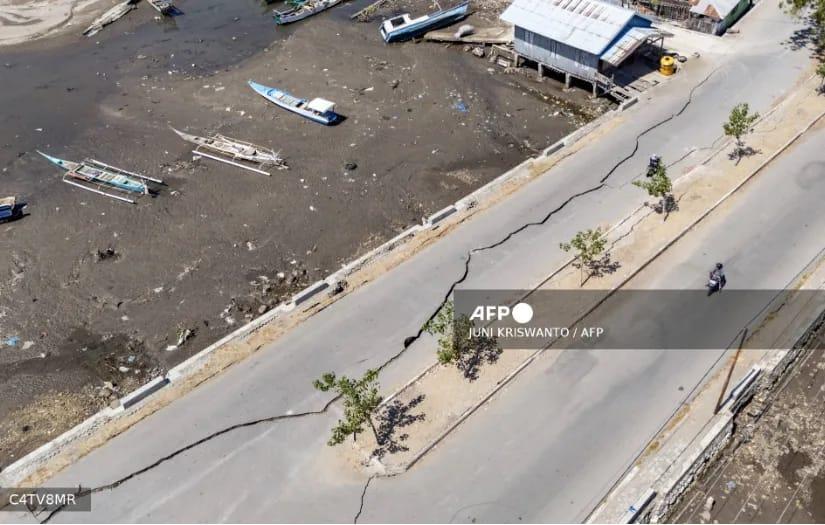
Following a devastating earthquake in eastern Indonesia, thousands of residents found themselves displaced, seeking refuge in schools, police stations, and government buildings while awaiting much-needed assistance on Monday. The powerful 7.7-magnitude tremor, which struck early Saturday, resulted in the deaths of 54 individuals and left over a hundred injured. Despite the widespread impact, rescue authorities confirmed that no persons were reported missing.
By Monday morning, the count of individuals displaced from their residences had escalated to 12,800, scattered across various communities on Flores island, according to Berton Suar Pelita Panjaitan, spokesperson for Indonesia’s BNPB national disaster agency, who spoke to AFP. Many residents on Flores were bracing for a third consecutive night sleeping outdoors, deterred from returning home by the more than 1,600 aftershocks recorded by the BMKG geological agency.
An AFP correspondent observed several inhabitants of Mbay, a small town in the Nagekeo regency close to the earthquake's epicentre, sheltering in temporary tents constructed from tarpaulins and poles. Junaidin, a 32-year-old Mbay resident, explained from outside a tent housing approximately 30 people, “Our houses are no longer liveable, because many have collapsed and are full of cracks, so we can’t go inside anymore.” He added, “We only go back home to get water, clothes, pillows, and then we… spend the nights here.”
The devastating 1992 7.7-magnitude earthquake that caused a tsunami and claimed around 2,500 lives on Flores island remains a traumatic memory for many inhabitants. Junaidin, a single-named Indonesian, voiced his distress, stating, “We’re on our own here.” He conveyed his disappointment regarding the slow arrival of relief efforts, especially as the country commemorated Independence Day with elaborate festivities in Jakarta. Junaidin lamented, “As for help from the government, there hasn’t been any — no tents, no medicine, no food, no drinking water, nothing.” He passionately appealed, “Please open your eyes, government. We are your people, we are part of you. So please look after us.”
In response, the Indonesian Air Force announced the deployment of two Hercules aircraft and a Boeing, transporting a total of 13 tonnes of emergency relief. Additionally, helicopters were being dispatched to deliver essential provisions directly to survivors in hard-to-reach areas, as reported by the Antara state news agency, citing the commander of El Tari Air Base in Kupang. These supplies comprised food, clothing, potable water, and urgent medical gear.
Military personnel have been deployed to assist with the distribution of aid at critical points. However, for the affected residents, assistance is arriving too slowly. Siti Saudah Daso, a 31-year-old mother of three from Mbay, recounted, “We fled with nothing. Just the clothes on our backs. We’re victims; we’re going through a disaster.” She expressed her frustration, saying, “They said they would give us something, but there’s no proof. So honestly, we’re a bit upset, disappointed.”
Search and rescue operations were ongoing, with teams meticulously searching the impacted region for potential victims, as confirmed by official Fathur Rahman to AFP. He stated, “We conduct land and air operations from helicopters. There haven’t been any reports on missing persons, but we are still scouring the area just to be sure.” Geological agencies pinpointed the shallow quake's epicentre just off Flores's northern coastline. The affected zones predominantly lacked high-rise structures. Berton, the disaster agency spokesperson, reported significant damage to at least 914 homes on the island, with hundreds more sustaining lesser damage. Numerous public infrastructures, including educational institutions, healthcare centers, and government offices, also suffered. Save the Children, an NGO, highlighted that over 8,000 children were confronting “safety risks and disruptions to their education” in the aftermath of the earthquake.
Given its position within the Pacific “Ring of Fire”—a zone of considerable seismic activity extending from Japan through Southeast Asia and across the Pacific basin—Indonesia is prone to frequent earthquakes. A prior catastrophic 9.1-magnitude quake in 2004, off Sumatra's coast, unleashed a tsunami that claimed 220,000 lives across the region, with approximately 170,000 fatalities in Indonesia alone, marking it as one of history's most lethal natural calamities.
Comments
(0)0/500 · No URLs or profanity allowed
Ah, dis Indonesia matter don break my heart o! Imagine earthquake don kill 54 people and thousands don lose dia house, yet dem say aid no dey reach fast. Omo, government for try dey quick for emergency situations like dis dis one, especially when people dey suffer.
Source: Punch NG
Related Stories

Blind but Unbroken: Comfort Ekwo's Inspiring Journey to Independence

Unizik Students Assault Alleged Lecturer Over Molestation Claim

UNIZIK Launches Probe into Alleged Lecturer Misconduct after Viral Video

UBEC Advocates Inclusive Education for Nigerian Children

ESUT Academics Begin Two-Week Strike Over Unmet ASUU Demands