Interior Minister Tunji-Ojo Contests Atiku's Claim on Closed Borders
Full Story
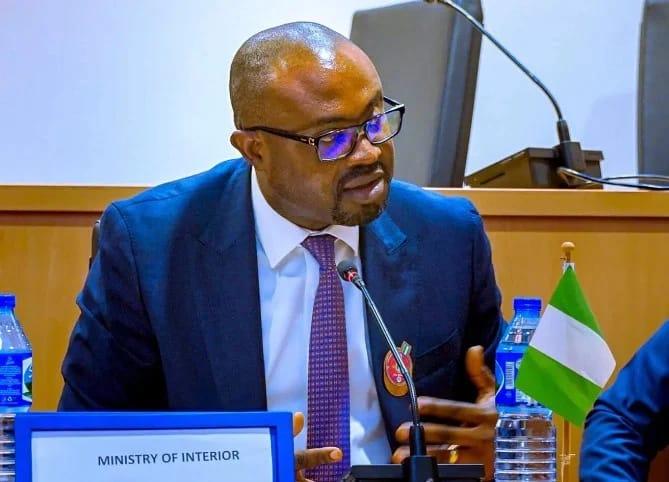
The Minister of Interior, Olubunmi Tunji-Ojo, has publicly challenged former Vice President Atiku Abubakar's assertion regarding the reopening of Nigeria's land borders, should he be elected President in 2027. Tunji-Ojo stated on Saturday that the country's borders are not currently closed, rendering any plan to 'reopen' them moot.
Responding to Atiku's recent remarks on his border policy, the Minister clarified that the Nigeria Immigration Service, operating under the Ministry of Interior, is responsible for managing both borders and migration. He stressed that the present administration actively facilitates regulated movement and commerce across the nation's entry points. Tunji-Ojo affirmed, “As the Minister of Interior who supervises the Nigeria Immigration Service, an agency of government in charge of border and migration management, it is expedient to state that Nigerian borders are not closed and so cannot be reopened.”
He further recalled that the previous government had already reopened four major land borders – Seme, Illela, Maigatari, and Mfum – on December 16, 2020. Subsequently, Idiroko and Ikom were also made accessible for goods and services on April 20, 2022.
Under the current administration, additional crossings at Kamba and Tsamiya in Kebbi State were reactivated in February 2026, providing vital links to Niger Republic and Benin Republic, respectively.
Tunji-Ojo also refuted Atiku's suggestion that borders with Cameroon, Chad, Niger, and Benin Republic experienced prolonged closures due to a 2019 trade policy. He explained that the situation along the Cameroonian border, specifically at Banki and Amchidé, was primarily a result of security threats posed by the Boko Haram insurgency.
“The prolonged closures on the Cameroon border, at Banki and Amchidé, did not arise from the 2019 trade policy at all. They date to 2014, when Boko Haram forced their closure for security reasons,” Tunji-Ojo elaborated. He noted that these crossings were reopened in 2019, with Fotokol and Gambaru following in 2021, after collaborative military and stabilization efforts by Nigeria, Cameroon, Niger, and Chad. He added, “Folding this separate, security-driven history into one continuous 2019 shutdown misrepresents two distinct issues, trade regulation and counter-insurgency, as a single failure.”
The Minister acknowledged that certain northern crossings still face restrictions, attributing this to persistent security challenges in those areas. “Not every northern crossing is fully unrestricted today. Where banditry or residual insurgent activity persists, tighter control is a deliberate security judgement, not neglect,” he stated.
He warned against the dangers of reopening border points without first improving the security landscape, as such actions could expose traders and local communities to heightened risks. Tunji-Ojo emphasized that effective border management involves a blend of security measures, proper documentation, customs adherence, and trade facilitation, rather than an all-or-nothing approach of complete closure or unrestricted access. “Modern border management is not a choice between total closure and unrestricted movement; it requires security, documentation, customs compliance and controlled trade facilitation together,” he asserted.
Tunji-Ojo challenged Atiku to present a comprehensive outline of his proposed border policy if he aims to become president, rather than treating the country's diverse trade, security, and infrastructure issues as a singular problem. “If he has a new border proposal, he should set it out and explain how it differs from the current approach, rather than treating separate trade, security and infrastructure issues as one and the same,” the Minister urged.
He concluded by cautioning against the manipulation of recent developments in Nigeria's border management for political gain, stating, “Political competition should not become a competition to rewrite recent history.”
Atiku Abubakar, who has contested for the presidency in six election cycles since 1993, had also previously advocated for the development of seaports in the South-South and South-East regions. This proposal aimed to rectify what he described as an imbalance in Nigeria’s import and transportation infrastructure. During his 2023 presidential campaign, Atiku mentioned engaging with European shippers and ship-development companies to garner support for these proposed ports. Currently, Nigeria’s busiest seaports are concentrated in Lagos, despite coastal states like Akwa Ibom and Bayelsa having direct access to the Atlantic Ocean.
Comments
(0)0/500 · No URLs or profanity allowed
Minister Tunji-Ojo don come out strong, dey tell Atiku say e no fit reopen something wey no close. E be like say na early campaign talk for 2027 we dey hear, as dem dey throw facts and figures around.
Source: Punch NG
Related Stories
Kaduna Governor: North-West Must Reward Tinubu's Impact with 2027 Votes
Violence, Irregularities Force YPP Boycott of Anambra Local Government Election
Details emerge: VP Shettima Seeks Stronger Accountability for Food Security Interventions
VP Shettima Heads to Angola for AU Summit, Represents Tinubu on Peace Mission
INEC Confirms Twelve Contenders for Kwara 2027 Governorship Election