Beyond Constitution: Moghalu Says Policing Bill Key to State Police Rollout
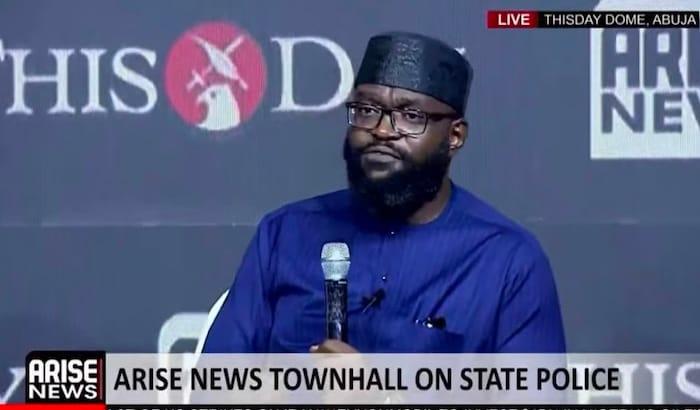
Mr. Dubem Moghalu, who serves as the Secretary for the Presidential Working Group on the National Policing Bill, has stated that the proposed legislation is essential for establishing the legal and operational framework needed to implement state policing across Nigeria. He emphasized that merely amending the constitution would not be sufficient to create or effectively run a state police system.
Moghalu made these remarks during the ARISE News Town Hall event focused on State Police and National Security. He informed attendees that the committee tasked with drafting the National Policing Bill had only recently commenced its activities, following its formal inauguration by the Presidency.
He conveyed greetings from the Chief of Staff to the President, His Excellency Femi Gbajabiamila, who was unable to attend due to prior commitments. "I want to thank the ARISE Group for the opportunity to participate in this town hall on National Policing and National Security. I also bring the greetings and best wishes of the Chief of Staff to the President, His Excellency, the Right Honourable Femi Gbajabiamila, who would have loved to be here today but is unavoidably absent due to prior engagements," Moghalu stated.
Addressing inquiries about the progress of the National Policing Bill, Moghalu confirmed that the Presidential Working Group was inaugurated just two days prior to the event. The group is chaired by the Chief of Staff to the President and comprises key figures including the National Security Adviser, the Attorney General of the Federation, the Governors of Kwara and Ogun states (who lead the Nigeria Governors’ Forum and its Committee on State Police respectively), representatives from the Nigerian Bar Association, and the Inspector General of Police.
He clarified that while the constitutional amendment, which has already passed the Senate and is moving through the legislative process, provides a legal pathway for state policing, it does not, by itself, establish a state police force. "The constitutional amendment that has passed the Senate and is progressing through the legislative process is an establishment document. It creates the constitutional pathway for state policing, but it does not expressly initiate state policing in the country."
According to Moghalu, the National Policing Bill is designed to provide the necessary operational framework to ensure state policing can function effectively nationwide. He explained: "For us to operationalise state policing, to put in place the infrastructure, establish national minimum standards for recruitment and training, and address issues relating to cooperation between the different state police services and the federal police, all of these questions will have to be resolved in the National Policing Bill that is now being drafted."
He further noted that Nigeria's current constitutional and legal structure was built around a single national police force, highlighting the need for extensive legislative reforms. "We also have to understand that the entire architecture of our Constitution and our national security laws exists on the assumption of a unitary police system. Amending the Constitution and enacting a National Policing Bill are only two steps. Several consequential amendments will still have to be made to ensure that the entire body of our laws reflects a dual policing system."
Regarding international policing models, Moghalu stressed that the committee is intentionally avoiding a direct replication of foreign systems. He insisted that Nigeria's policing framework must be uniquely tailored to its own realities. "One of the things we are trying to avoid is a copy-and-paste approach. Throughout this town hall, many speakers have referred to the American policing model, with federal, state and local police structures. We are not trying to recreate the American policing model in Nigeria."
He added: "What we are trying to do is to develop our own dual policing system that reflects our realities, our concerns and the challenges we are trying to address." Moghalu elaborated that policing evolved differently in countries like the United States, making direct comparisons inappropriate. He pointed out that in the U.S., policing originated from communities upwards, with the Federal Bureau of Investigation (FBI) serving as a federal investigative body rather than a traditional federal police force.
Moghalu contrasted this with Nigeria's situation, where a federal policing structure is already in place, and the country is transitioning from a unitary to a dual system. He emphasized the importance of adopting best practices from other jurisdictions without simply transplanting their entire systems, as they might not suit Nigeria's unique environment. He concluded by affirming that the reforms would be specifically adapted to Nigeria's constitutional framework and security needs to ensure a robust and sustainable state policing system.
Videos
Comments
(0)0/500 · No URLs or profanity allowed
This matter of state police don dey drag for long! Moghalu don talk say we need proper bill, not just constitution change, to make am work. We just pray say dem no go just dey talk, make dem really do am so security for our country go better.
Source: Arise TV
Related Stories
Abiodun Confident All State Assemblies Will Simultaneously Pass Police Bill
Natasha Akpoti-Uduaghan Calls for Robust Checks on State Police Power

Viral Memo Alleges Palm Beach International Airport to Bear Donald J. Trump's Name
Nothing Must Happen to Obi and El-Rufai, Atiku Warns Tinubu
Presidency Addresses Peter Obi's Security Worries