The Electric Merchant of Alaba International
Full Story
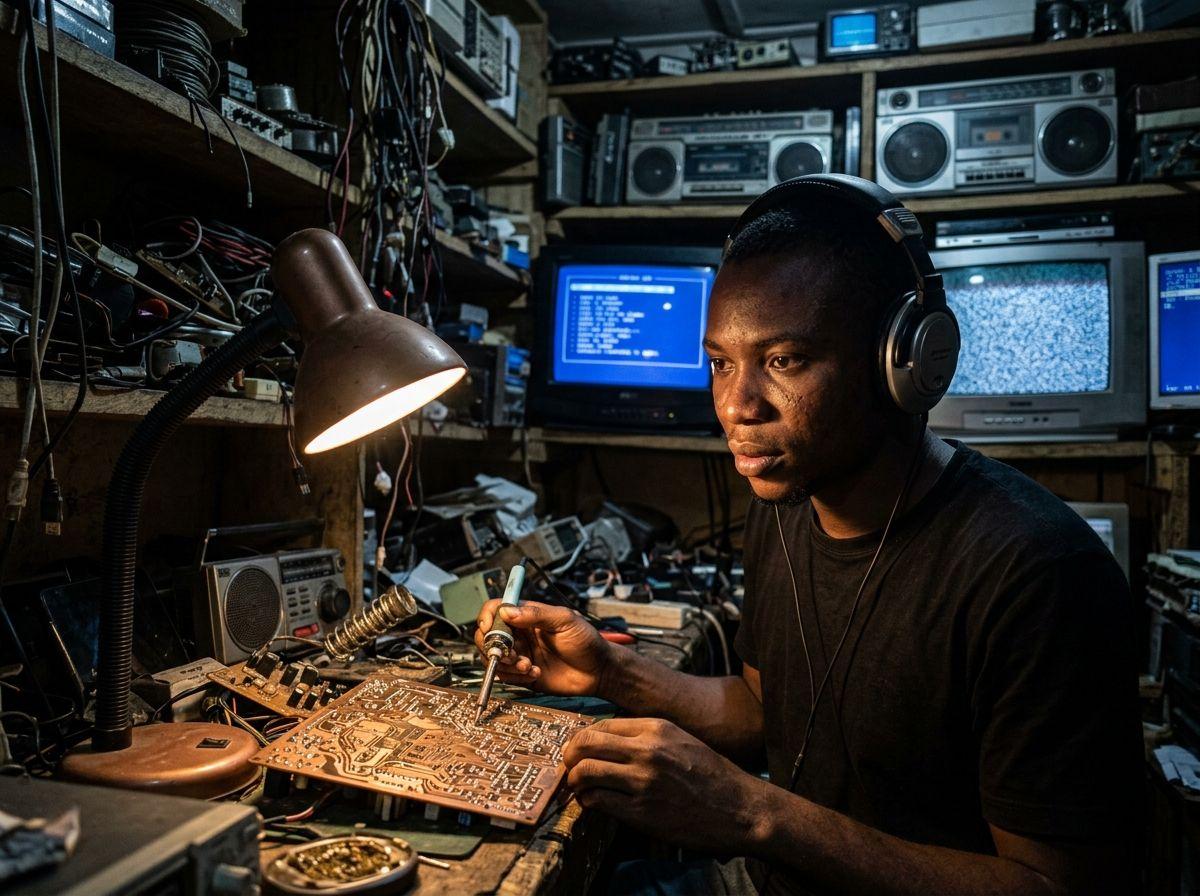
Inside the chaotic maze of Alaba International Market, thirty-two-year-old audio engineer Emeka was famous for fixing electronics that every other technician declared dead. His small workshop was stacked to the ceiling with copper coils, disassembled shortwave radios, and discarded amplifier motherboards from the 1990s.
Late on a rainy Thursday evening, while solder-repairing an unbranded vintage receiver brought in by an elderly trader, the machine gave off a high-pitched hum. When Emeka plugged in his monitor headphones, he didn't hear radio static or commercial broadcasts; he heard clear, quiet conversations taking place inside an empty office building five miles away. As he turned the copper tuning knob counter-clockwise, the frequencies shifted backward—broadcasting spoken conversations that had occurred in that exact spot twenty years ago.
Realistic Image Prompt (to appear in text): Close-up, low-key lighting portrait of a focused young Nigerian electronics technician, late twenties, sitting at a cluttered workbench inside a dimly lit stall in Alaba International Market. The primary light source is a focused, warm desk lamp illuminating a vintage, complex copper circuit board. He is wearing old, professional over-ear headphones, a subtle pained or anxious expression on his face, his skin showing natural pores and light texture. He is holding a soldering iron near the board. Realistically chaotic background filled with shelves of old wires, CRT monitors displaying blue screen text, and discarded electronic components. Shot on a Canon EOS 5D Mark IV, realistic low-light noise (grain), shallow depth of field, candid capture.
Comments
(0)0/500 · No URLs or profanity allowed
Inside the chaotic maze of Alaba International Market, thirty-two-year-old audio engineer Emeka was famous for fixing electronics that every other technician declared dead. His small workshop was stacked to the ceiling with copper coils, disassembled shortwave radios, and discarded amplifier motherboards from the 1990s. Late on a rainy Thursday evening, while solder-repairing an unbranded vintage receiver brought in by an elderly trader, the machine gave off a high-pitched hum. When Emeka plugged in his monitor headphones, he didn't hear radio static or commercial broadcasts; he heard clear, quiet conversations taking place inside an empty office building five miles away. As he turned the copper tuning knob counter-clockwise, the frequencies shifted backward—broadcasting spoken conversations that had occurred in that exact spot twenty years ago.
Related Stories

The Unplugged Rebound: Why Afrobeats Producers Are Ditching Digital Synthesizers for Live Percussion Orchestras

Beyond B2B E-Commerce: How Offline USSD Mesh Protocols Are Reclaiming Nigeria’s Rural Agriculture

Beyond Payments: Nigeria’s Open Banking Framework Set to Unlock Personalized Lending and Insurance
The Death of the 2-Hour Movie: How Nigerian Micro-Dramas Are Rewriting African Cinema
Beyond Lagos and Abuja: Why Nigeria’s Next Tech Frontier Is Quietly Building in Kwara and Enugu