US President Trump Threatens EU Trade Freeze Over Canada's Associate Membership Bid
Full Story
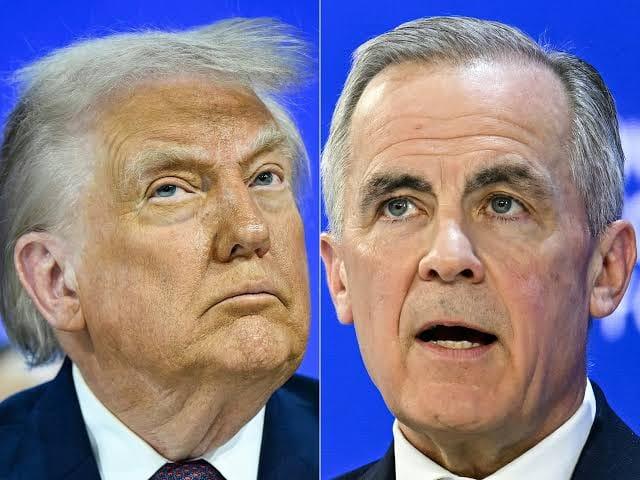
United States President, Donald Trump, has issued a strong warning to the European Union, indicating potential “serious tariffs” and a complete cessation of trade. This declaration follows the EU's proposal to designate Canada as its inaugural associate member, a concept Trump vehemently dismissed as “laughable.” Trump stated that should the EU proceed with this initiative, Washington might implement “very serious tariffs or stop trading with Europe.” He further elaborated, “If it’s a good intention, that’s fine. If it’s a bad intention, we’ll put very heavy tariffs on Europe.”
Meanwhile, Canadian Prime Minister Mark Carney is scheduled to address the European Parliament on Thursday. This address comes just a day after European Commission President, Ursula von der Leyen, extended an invitation for Canada to become the EU’s first “associate member.” Von der Leyen presented Carney with opportunities for enhanced collaboration across technology, defence, and energy sectors. She conveyed to the European Parliament that in an era where democracies confront a “fracture in the international rules-based system,” there is a pressing need for Brussels and Ottawa to strengthen their ties. In her words, “This is a partnership not against anyone else, but for our common strength. In short, we want to bring the relationship with Canada to the highest level possible.”
Responding to President Trump’s remarks, Benjamin Haddad, France’s Europe Minister, asserted that Washington lacks the authority to veto decisions made by the EU. Haddad declared, “It is not up to the United States, or anyone else, to choose the political and geopolitical direction of the Europeans. Once again, we have a relationship with Canada, and we are fully entitled to seek to deepen it.” A spokesperson for the European Commission echoed this sentiment, stating, “As our president made clear yesterday, the proposed strengthening of the relationship with Canada is not against anyone else, but for our common strength.”
Prime Minister Carney has advocated for a “unique alliance” with the EU, aiming to lessen Canada's significant reliance on trade with the United States. Following discussions with EU leaders in Strasbourg, he characterized the EU and Canada as “natural partners, united by shared values,” emphasizing that both entities are committed to “a deeper partnership that reinforces our mutual sovereignty to create more opportunities and prosperity for our peoples.” While the EU’s 27 member states largely favour enhanced engagement with Canada, the specific term “associate membership” reportedly caught them off guard. Notably, Canada and the EU already share a trade agreement and various bilateral accords. Their relationship has intensified particularly since Donald Trump’s return to the White House, marked by his imposition of tariffs on long-standing allies, his recurring suggestions of Canada becoming the 51st US state, and his frequent criticisms of the EU.
Further signalling Canada's intent to broaden its defence partnerships beyond the US, Carney’s office revealed the nation’s formal application to join the British-led Joint Expeditionary Force (JEF) military coalition. The JEF is a rapid response military alliance composed of 10 North Atlantic NATO member states, among them Denmark, the Netherlands, Norway, and Sweden. Coincidentally, Prime Minister Carney and British Prime Minister Andy Burnham conducted a bilateral meeting at Everton football club’s stadium before watching the team play against Wolves. Their discussions encompassed strengthening defence collaboration and exploring the prospects and hurdles associated with artificial intelligence. Downing Street later communicated that both prime ministers underscored the significance of fostering robust relationships with European allies, especially in the areas of trade and defence.
It is worth noting that the 27-member EU has historically not featured an associate membership category. While it maintains strong relationships with nations like Norway, Iceland, and Switzerland, facilitating significant economic integration where these countries adhere to numerous EU regulations, the precise implications of “associate membership” for Canada’s engagement with the EU single market are yet to be fully defined. Von der Leyen articulated a vision to transition from trade-centric cooperation to a more expansive “alliance for the future,” aiming to elevate the relationship with Canada to its utmost potential. She outlined key areas: “We will work on intelligent manufacturing. We will create a tech alliance. We will integrate defence industrial bases. We will make the Arctic a flagship joint project.” She reiterated these points, further listing energy, critical minerals, batteries, AI, cyber, and economic security as additional domains for collaborative effort. She concluded by affirming, “This is a partnership not against anyone else, but for our common strength.”
Gallery
Comments
(0)0/500 · No URLs or profanity allowed
Na wa oh! Trump don vex say EU wan give Canada special status. Him say if dem try am, na trade wahala go burst. We go see how dis gbege go end o.
Source: Linda Ikeji's Blog
Related Stories
Palestinian President Abbas Blocked From UN General Assembly by US Visa Denial
Israel's Defence Minister Katz Vows to 'Finish Job' in Gaza, Relocate Population
Hormuz Strait Peace Dialogue Put Off Amid Gulf, US Concerns
After 62 Hours at Sea, Derek Aghnaanga, 15, Shares Grim Details

Beijing Rejects Allegations of Aiding Iran in Deadly US Base Attack