Francis Origa: Aid Worker Attacks Cripple Northeast Nigeria Relief Operations
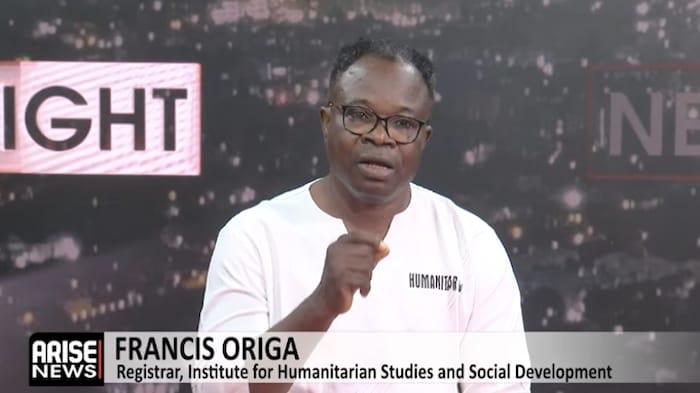
Francis Origa, who serves as the Registrar for the Institute for Humanitarian Studies and Social Development, has strongly condemned the escalating assaults targeting humanitarian aid workers. He issued a stern warning that the prevailing insecurity is significantly impeding relief efforts and deterring individuals from engaging in humanitarian initiatives, especially across Nigeria's Northeast region. Speaking on ARISE NEWS on Wednesday, coinciding with the global observance of World Humanitarian Day, Origa voiced profound concern regarding the increasing dangers encountered by those providing aid, particularly in areas affected by conflict. He emphasized that such aggressions could severely undermine crucial assistance efforts aimed at vulnerable communities.
Origa lamented the dire situation, stating, "Just within three months, according to the United Nations, we recorded 1,932 persons killed. Now, this hinders the activities and operations of humanitarian aid workers, particularly in the northeastern part of Nigeria where humanitarian aid operations, relief operations, are ongoing. Now, people who would want to get involved will fear for their life."
While acknowledging that attacks on humanitarian personnel are a global issue, Origa highlighted Nigeria's situation as uniquely problematic. He underscored that insecurity transcends ethnic, religious, and political divides, leaving citizens susceptible to harm. "It is a global problem. But Nigeria’s problem is very peculiar. When your security is not guaranteed from point A state to another state, it calls for worry. And it does not respect ethnicity, it does not respect religion, it does not respect political affiliation," he asserted.
Advocating for a shift from purely security-focused interventions to a comprehensive human security paradigm, Origa implored governments to address the fundamental drivers of insecurity. These include widespread unemployment, pervasive poverty, and hunger. He also called for sustainable socio-economic empowerment programs tailored for young people. "I always like to talk about it from the perception of the approach of the human security components. Now, the UN human security component has already outlined that we should focus more on developmental approach. That there are more to the things that are leading to insecurity, other than responding when something happens with deployed security men, with deployed police, with deployed military," he explained.
Origa further elaborated, "There are rooted challenges which include unemployment, which include poverty, just as the Goal 1 of the Sustainable Development Goals addresses the issue of poverty, and Goal 2 is looking at hunger. So, if governments really would attack some of these problems and address it from its root causes, then it would need to approach it from the perspective of the human security approach where you address hunger, where you address poverty, where you address sustainable socio-economic empowerment of both the teeming youth population, most especially, who are caught in the web of these crimes and criminalities."
Furthermore, Origa challenged the official estimates of internally displaced persons (IDPs) in Nigeria, asserting that the actual figure exceeds five million. He stressed the imperative of tackling both the causes of displacement and ensuring the well-being of those affected. "We have over 5 million. Because in Benue State alone, we have over 500,000 internally displaced persons in Benue State. You go to Edo State, housed by Home for the Needy, we have more than 5,000 of them. Now, 4,000 of them are in the camp. About 1,000 of them are in clusters within the community that this Home for the Needy takes care of," he detailed.
He concluded by emphasizing a dual approach: "How are we even taking care of the internally displaced persons? Yes, there are two things to it. We look at the causes—why are we having the increase in the internally displaced persons? But then, the fact remains that whatever thing that must have occurred that has led to it, we need to address. While addressing that, we also need to take care of the internally displaced persons."
Comments
(0)0/500 · No URLs or profanity allowed
Dis attacks wey aid workers dey face for Northeast na serious matter, dem dey make am hard for help to reach people wey need am. Origa talk say government suppose face wetin dey cause di problem, like too much poverty and people no get work. We just hope say dem go hear word and do something quick.
Source: Arise TV
Related Stories

The Terrorists Released Us Before Soldiers Took Us Home” – Rescued Oyo Teacher Reveals Shocking Details of 56-Day Ordeal
New Mineral Discoveries Could Bring 'Oil Curse' Repeat, Experts Caution Nigeria

Terrorism fight gets boost as FG crafts disarmament guidelines
Bloodshed in Plateau as Gunmen Slaughter Nine in One Family, Including Infant

Kaduna-Bound Journey Ends in Tragedy for Five ECWA Wuse II Members