UK Varsities Revoke Admission Slots for Nigerians Amidst Visa Clampdown
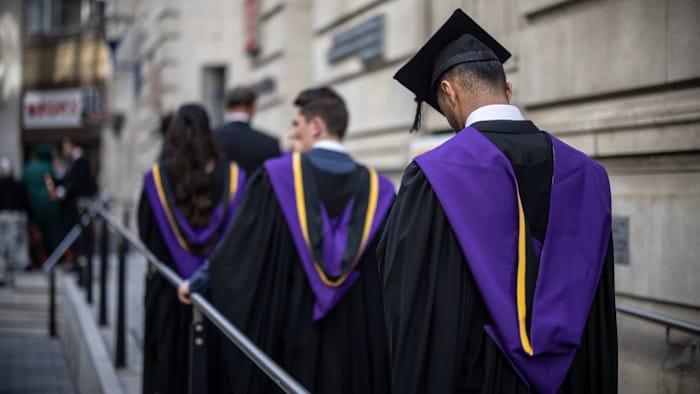
Full Story
United Kingdom higher education institutions are currently rescinding admission offers previously extended to international students, notably those from Nigeria and Pakistan. This development, as reported by the Financial Times, stems from growing apprehension that an increasing trend of visa refusals could jeopardise their capacity to attract students from abroad. An examination of data from the Home Office by the newspaper revealed a significant surge in the withdrawal of Nigerian study visa applications, rising to 22.7 percent in the first half of 2026 from 4.5 percent in the corresponding period of 2025. Similarly, Pakistani applicants saw their withdrawal rates jump from 3 percent to 40.9 percent, while Bangladesh experienced an increase from 7.1 percent to 23.5 percent. Indian applicants also witnessed a rise in this proportion, from 1.2 percent to 5.2 percent. Collectively, 10.5 percent of all study visa applications were withdrawn in the initial six months of 2026, a sharp increase from 2.3 percent a year prior and 0.4 percent in 2023.
Prospective international students are only eligible to apply for a study visa once they have secured an admission offer from a university. Should a university later retract this offer, the associated visa application is consequently withdrawn. While various factors can lead to application withdrawals, universities indicate that the recent spike is primarily due to institutions revoking offers. They link this trend to a twofold increase in study visa rejections observed in the first half of 2026 compared to the previous year, coupled with more stringent regulations for sponsoring international students. New guidelines stipulate that universities face potential prohibition from recruiting foreign students if their visa refusal rate for offered applicants exceeds five percent, a significant reduction from the earlier 10 percent threshold.
The report further highlights that the surge in visa refusals is particularly pronounced among citizens from countries that the government suspects of exploiting the student visa pathway to claim asylum. It is estimated that approximately 15 universities have completely halted their recruitment efforts in Pakistan this year. Furthermore, figures from Enroly, a firm specialising in visa processing, indicate that nearly half of all universities now have refusal rates surpassing the five percent compliance limit.
Sir David Bell, Vice-Chancellor of the University of Sunderland, stated that institutions are implementing precautionary measures. He remarked, “The recent and unexpected spike in visa refusals has prompted pre-emptive action in several universities. This has involved pulling back from international markets where a tougher approach is being taken to visa applications.” Jamie Arrowsmith, who serves as the director of Universities UK International, acknowledged the necessity of preserving public trust in the immigration framework. However, he noted that “visa processing has become markedly less predictable.” Arrowsmith further elaborated, “Many refusals appear to rest on flawed, inconsistent and highly subjective reasoning, forcing universities to withdraw offers at scale to avoid breaching compliance thresholds.”
Leaders within the university sector have cautioned that these new restrictions could intensify financial strain. This is due to stricter immigration policies and heightened global competition reducing the number of international applications, thereby endangering a vital revenue stream. Vanessa Wilson, chief executive of University Alliance, an organisation representing 20 professional and technical universities, warned, “This is going to result in restructures, which inevitably results in job losses, course closures, campus closures.” Universities also reported instances where visa applicants were denied simply for having explored study options in other nations previously. In one notable case, a PhD candidate was reportedly asked to list course modules, even though a research degree typically does not have such a structure.
Professor Steven McGuire, the deputy vice-chancellor at the University of East Anglia, disclosed that his institution commenced withdrawing offers from specific countries towards the end of last year, subsequent to a significant rise in visa rejections. He recounted, “We were getting some very arbitrary and ill-informed refusals.” He further illustrated this with an example: “We had one where the interviewer did not seem to understand that UEA was in Norwich [and so rejected the applicant for not knowing where they were going to study].” McGuire expressed concern that this policy might compel universities to disproportionately focus on recruiting from “China and India,” regions with comparatively lower refusal rates. He added that with a decrease in international student fee income, universities were “running out of options except a very significant resizing of the sector.”
Professor James Miller, who serves as the vice-chancellor of the University of the West of Scotland and convener of Universities Scotland, characterised some of the visa refusals as “extremely spurious.” He noted that the Home Office had provided “no real explanation [for the increase] other than concern about number of students claiming asylum.” Miller also mentioned that certain universities have “stopped recruiting from certain geographical areas to keep refusal rates below 5 per cent.” He cautioned that without a policy alteration, numerous institutions could face a reduction of over 20 percent in their international student population this year, rendering job cuts “inevitable.” He concluded that this situation is “harming the UK’s reputat
Comments
(0)0/500 · No URLs or profanity allowed
Chei! UK universities don dey revoke admission for our Naija students because of visa wahala. Na serious matter o, this one fit scatter many people's japa dream and even affect how dem see UK education.
Source: Linda Ikeji's Blog
Related Stories

Cross River State Government Seals Off 20 Unlicensed Learning Centres
UK Universities Pulling Nigerian Student Offers Amidst Tougher Immigration Policy
ASUU Ends Industrial Action: LASU, LASUED, LASUSTECH Lecturers Back to Class
Tinubu Administration Settles N758bn Pension Debt Dating Back to 2007

Federal Government Honours Top Teachers, Schools with 2026 Presidential Awards