COP31: Experts Challenge NNPC to Juggle Oil Revenue with Green Energy Future
Full Story
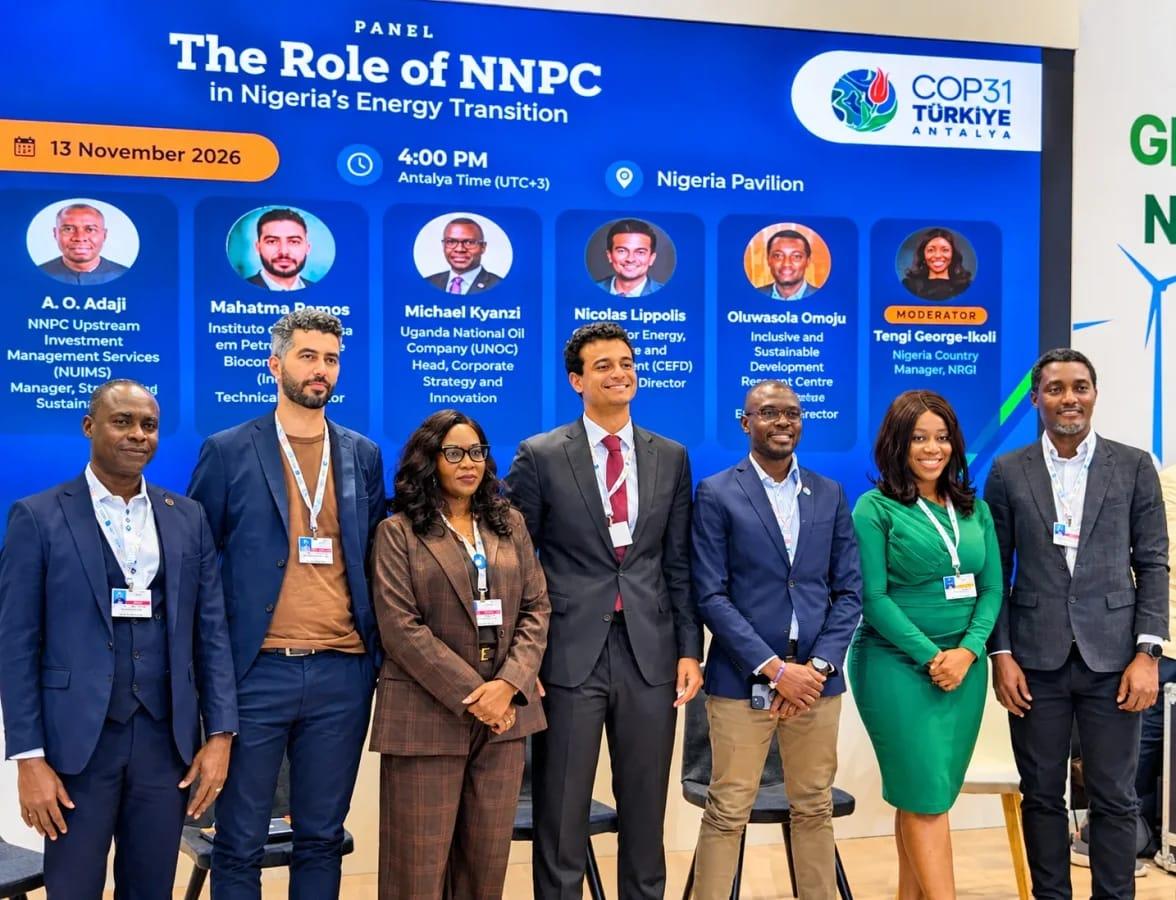
Industry specialists have called on the Nigerian National Petroleum Company Limited (NNPCL) to reconcile its profit-driven objectives with Nigeria's broader economic goals, particularly as the worldwide movement towards sustainable energy sources casts a shadow over the longevity of fossil fuel investments. According to energy analysts and researchers, the choices NNPCL makes—whether to boost oil and gas ventures, pivot to renewable energy, or progressively phase out fossil fuels—will profoundly affect national income, job creation, energy stability, and the overall economic landscape.
These recommendations were presented during a panel discussion, "The Role of NNPC in Nigeria’s Energy Transition," held on Friday at the ongoing 31st United Nations Climate Change Conference (COP31) in Antalya, Türkiye. The event was co-hosted by the Centre for Petroleum, Energy Economics and Law (University of Ibadan), the Centre for Energy, Finance and Development, and the Inclusive and Sustainable Development Research Centre. Tengi George-Ikoli, who serves as the Nigeria Country Manager for the Natural Resource Governance Institute, facilitated the discussion.
George-Ikoli highlighted that national oil companies (NOCs) are crucial in shaping the global success of a managed reduction in fossil fuel output, especially as International Oil Companies (IOCs) reassess their investment portfolios. She further observed that NOCs could bridge the investment void created by the scaling back of international operators, rendering their strategic decisions vital for the energy transition process. "National oil companies will play a major role in determining the success of the push for a managed decline in fossil fuel production globally. As international oil companies scale back, NOCs may step in to fill the gap, making their involvement in the transition essential. This is particularly true for NNPC in Nigeria," George-Ikoli stated.
She also pointed out that collaborative discussions at COP31, featuring Nigeria, Senegal, and Uganda, underscored the value of peer learning, aiding nations in grasping their unique situations and formulating collective solutions to common energy dilemmas. George-Ikoli emphasized that Nigeria needs to transcend mere dialogue, ensuring NNPCL collaborates with the Federal Government to evaluate long-term investment vulnerabilities, anticipate decreasing fossil fuel demand, and devise robust transition roadmaps.
During his presentation, Nicolas Lippolis, Executive Director of the Centre for Energy, Finance and Development, explained that the Petroleum Industry Act (PIA) of 2021 has reconfigured NNPC into a profit-driven entity, necessitating a balance between its commercial viability and its duties to the public. Lippolis stressed that NNPCL is mandated to generate revenue for the government, ensure national energy security, and bolster local production, all while ensuring its investments remain sustainable amidst evolving global energy markets. He observed that roughly 35 percent of NNPCL's income originates from crude oil and gas exports, and petroleum products constitute about 85 percent of Nigeria's total exports, making the nation highly susceptible to fluctuations in worldwide demand.
Lippolis's study highlighted gas-fired power generation, domestic midstream infrastructure, and international pipelines as critical sectors demanding careful examination due to their potential susceptibility to energy transition-related risks. He further elucidated that projects involving private and international collaborations would benefit from independent market assessments, which would assist NNPCL in verifying the commercial viability and demand sustainability of such ventures. The researcher also underscored the importance of exploring how NNPCL could integrate its current expertise with investments in renewable energy sources and low-carbon industrial initiatives.
In a similar vein, Oluwasola Omoju, Executive Director of the Inclusive and Sustainable Development Research Centre, cautioned that NNPCL's decisions regarding its energy transition would have repercussions extending far beyond the oil sector, impacting Nigeria's broader economy. Through an economic modelling assessment, Omoju analyzed three potential approaches: NNPCL divesting from fossil fuel assets, redirecting investments towards natural gas, and the capture and commercialization of currently flared gas. His findings indicated that each of these transition paths could lead to adverse macroeconomic effects, with government revenue expected to decrease as the economy adapts to a lessened reliance on oil and gas resources.
Nevertheless, Omoju pointed out potential employment opportunities, especially within refining and industrial activities, which could provide jobs for those dislocated by shifts within the energy industry. He emphasized that the ultimate economic outcomes hinge on the specific strategy NNPCL implements and the degree to which the Federal Government offers supportive policies and financial structures. Concluding the session, A.O. Adaji, Manager of Strategy and Sustainability at NNPC Upstream Investment Management Services, affirmed that the national oil company is adopting a diversified energy mix approach for its transition, rather than focusing on a singular strategy.
Comments
(0)0/500 · No URLs or profanity allowed
Dem say NNPC get serious work for hand, to balance crude oil money with this new energy wey dey come. We just hope say dem go do am well so Nigeria no go carry last for global energy market.
Source: Punch NG
Related Stories

Kaduna, FG Officials Promise Enhanced Support for Creative Youth Ventures

NCoS CG Warns: Ex-Offenders Face Crime Return Amid Joblessness, Stigmatisation
Dr. Olowolafe Urges World-Class Hospitality for Ikogosi's Growth in Ekiti

Sanwo-Olu Outlines Lagos' Vision for $1 Trillion Economy by 2052
Inferno Sweeps Through Shops at Ikotun Market, Lagos