Barely 1% of Lagosians Benefit from LWC's Water Distribution Network
Full Story
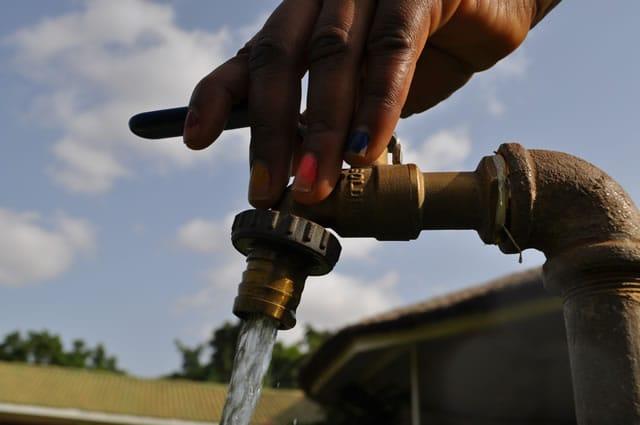
The Lagos Water Corporation (LWC) has disclosed that its existing water network provides service to merely 34,424 registered households, a figure that accounts for only about 1.03 percent of the state's estimated population of 20 million people. This revelation came from Mr. Rasaq Anifowoshe, the Deputy Director for Corporate Affairs and Brand Management at the LWC, during an exclusive conversation with the News Agency of Nigeria (NAN) in Lagos, as reported on Sunday. Anifowoshe offered this insight while addressing inquiries concerning the LWC's current water coverage and its proposed expansion strategies.
He explained, "Based on an estimated average household comprising six individuals, the total number of residents linked to these connections stands at 206,444, which is roughly 1.03 percent of the state's projected 20 million inhabitants." Furthermore, Anifowoshe revealed that the corporation possesses an installed capacity to produce approximately 210 million gallons of water daily. This capacity, he noted, falls significantly short when compared to the state's estimated daily water requirement of about 540 million gallons per day (MGD), a figure outlined in the Lagos State Water Supply Master Plan.
"An analysis of the corporation's production data for 2025," he stated, "shows an overall annual output of approximately 2,633.22 million gallons, translating to an average daily production of around 7.21 MGD." He added, "These records indicate that the actual daily production represents only three percent of the installed capacity." The figures presented by NAN underscore a considerable disparity between the LWC's installed production capacity, its actual operational output, and the overall estimated water demand throughout Lagos State.
Anifowoshe pinpointed several key challenges, including deteriorating distribution pipelines, escalating demand fueled by population expansion and swift urban development, and the urgent necessity to restore and enlarge current water infrastructure. According to NAN, these obstacles severely hamper the corporation's capability to broaden public water access, especially in areas where residents depend heavily on boreholes and independent water suppliers.
Throughout Lagos, households incur significant expenses, often thousands of naira, for alternative water provisions due to inconsistent public supply and the unavailability of connections, which consequently inflates their living costs. Interviews conducted by NAN with several Lagos residents in Iponri, Oworonshoki, Costain, Apapa Road, and Ebute Metta brought to light widespread worries regarding erratic supply, malfunctioning infrastructure, and insufficient water pressure.
At Iponri Housing Estate, Mr. Adebayo Solomon shared that his family spends approximately N1,500 each day on water purchased from vendors, accumulating to about N45,000 every month. Solomon calculated that if this expenditure continued for a full year, the total cost would reach around N547,500. He further explained that power outages occasionally interrupt water availability, compelling his household to conserve stored water or pay inflated prices. He expressed his eagerness for an LWC connection, provided it guaranteed a consistent supply and lessened their reliance on private vendors.
Mr. Abdulkareem Ibrahim, another resident of Iponri, mentioned that his community does not receive LWC water, forcing him to depend on public boreholes funded by benevolent individuals. "I rely on public water, specifically what philanthropists have provided," he stated. "I usually fetch it either in the mornings or after I return from work at night." Ibrahim noted that while these boreholes help him avoid direct costs for water, power disruptions sometimes interfere with the pumping process, obliging him to purchase water from vendors. He concluded, "I'm simply grateful that we have water at all, thanks entirely to our generous neighbours."
In Oworonshoki, Mrs. Amanda Ogbodo recounted spending between N2,200 and N3,600 each week on borehole water delivered by vendors. Over a four-week period, Ogbodo stated that this expenditure totals between N8,800 and N14,400. She also observed, as did other residents interviewed across the state, that LWC water had been flowing with greater consistency in certain sections of her locality over the past four months, primarily from Friday afternoons through Saturday.
The testimonies from residents vividly illustrate how unreliable supply, dysfunctional infrastructure, and insufficient water pressure compel households to resort to alternative sources, even in communities that theoretically possess public water connections. These personal accounts bring into question the true extent of public water infrastructure, the dependability of its supply, and whether government-announced interventions are genuinely leading to better access for citizens.
Meanwhile, the Lagos State Government’s budget implementation report for the second quarter of 2026 indicated that by June 30, 36.2 percent of the allocated annual budget designated for the enhancement of 15 existing mini and micro waterworks had been disbursed. Additionally, the report documented an expenditure equivalent to four percent of the sanctioned annual budget for the Adiyan Phase II Waterworks project. It is important to note that these expenditure figures do not provide clarity on the physical completion status of these projects or the actual volume of water they are presently supplying.
Addressing the corporation's strategy to boost public water coverage statewide, Anifowoshe outlined plans for the restoration and modernization of various micro and mini water treatment plants. He stated, "Upon their full rehabilitation, these efforts are projected to make water accessible to more than 5,616,000 households, thereby allowing the corporation to fulfill its core mandate."
Gallery
Comments
(0)0/500 · No URLs or profanity allowed
Na wa oh! Lagos Water Corporation don confirm say dem dey supply water to only small pikin percentage of Lagosians. Wetin be government plan to make sure everybody get clean water for house, abi na only borehole we go dey manage?
Source: Punch NG
Related Stories

How to Earn Over $50K Annually from Top S&P 500 Dividend Stocks

Monthly Payouts: Five Dividend Stocks for Retiree Income Planning
Governor Zulum: Scavengers Looted N3bn Power Line Wires in Borno

Aliko Dangote Confident of $100 Billion Revenue, Egypt Integral to $50 Billion Africa Industrialization

Kano Governor Moves to Resettle 75 Traders from Demolished Eid Prayer Ground