Politics7 May 20262:20
Senate amends Electoral Act to clarify jurisdiction in election disputes
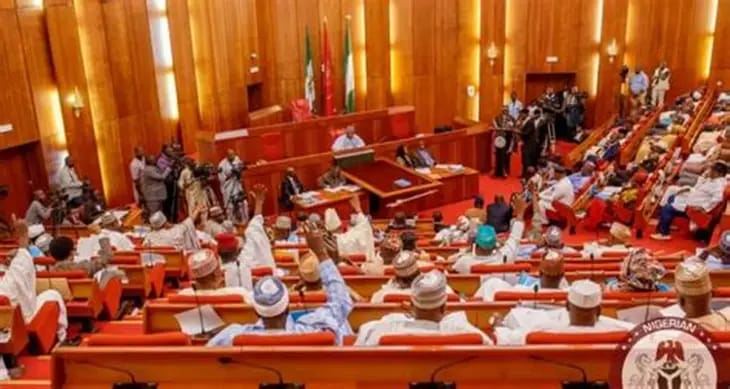
The Senate has passed an amendment to the 2026 Electoral Act Bill to establish a clearer legal framework for handling pre-election disputes. The amendment aims to address lingering jurisdictional disputes in the adjudication of pre-election matters. This move is expected to promote judicial efficiency and reduce delays in the resolution of electoral disputes.
The Senate on Thursday passed an amendment to the 2026 Electoral Act Bill, seeking to establish a clearer legal framework for the handling of pre-election disputes ahead of the next general elections. The bill was passed during plenary following the presentation and consideration of a report by the Senate Committee on the Independent National Electoral Commission, chaired by Simon Lalong. The proposed legislation amends Section 29 of the Electoral Act and introduces a new Section 29A aimed at addressing lingering jurisdictional disputes in the adjudication of pre-election matters. Leading the debate on the report, Lalong said the amendment became necessary due to persistent legal and constitutional controversies surrounding the interpretation of pre-election cases by courts across the country. “The legitimacy of candidates and the integrity of party primaries are foundational pillars of representative democracy. “Where the legal framework regulating pre-election disputes is uncertain or conflicting, the entire electoral architecture becomes vulnerable to confusion, forum shopping, contradictory judgments, and unnecessary delays,” Lalong said. He explained that despite the provisions of Section 285(14) of the 1999 Constitution defining pre-election matters, conflicting interpretations by courts had continued to create uncertainty in Nigeria’s electoral jurisprudence. According to him, the situation had resulted in “conflicting decisions from courts of coordinate jurisdiction, abuse of judicial process, undue delay in the resolution of electoral disputes, and avoidable constitutional tension between courts.” Under Clause 2 of the amendment, Section 29(5) of the principal Act is revised to allow an aspirant institute to bring an action either in the Federal Capital Territory or in the jurisdiction where the cause of action arose. Lalong described the provision as “both practical and equitable,” noting that it would reduce hardship on litigants and improve access to justice. The bill also introduces a new Section 29A, which provides a distinct hierarchy for the adjudication of pre-election matters. Under the proposal, disputes relating to National Assembly, governorship and state Houses of Assembly elections would originate at the Federal High Court, with appeals proceeding to the Court of Appeal. • SWAGA leaders root for Tinubu, Oyebanji’s re-election • Mass exit hits Oyo PDP as supporters await Makinde’s directive • APC primaries: Tinubu, govs, aspirants submit nomination forms For presidential and vice-presidential elections, however, such matters would originate directly at the Court of Appeal exercising original jurisdiction, with appeals lying at the Supreme Court. Lalong said the arrangement was designed to promote judicial efficiency and align with the constitutional importance of presidential elections. “Presidential elections are national in character and constitutional significance. “Given the sensitivity and urgency associated with such offices, vesting original jurisdiction in the Court of Appeal ensures expeditious determination by a superior court of record with nationwide competence and institutional capacity,” he said. He added that assigning other pre-election matters to the Federal High Court would encourage specialisation and consistency because of the federal nature of electoral administration by the Independent National Electoral Commission. The senator further said the amendment would curb the growing practice of litigants filing multiple suits in different courts in search of favourable rulings. “By expressly providing that no court shall entertain pre-election matters except in accordance with the proposed Section 29A, this amendment introduces certainty and procedural discipline into electoral adjudication,” he stated. According to him, the reform would create “a clear judicial pathway that will reduce delays and enhance judicial efficiency,” stressing that the amendment “is not merely procedural, it is institutional.” He said, “The amendment strengthens electoral justice, deepens democratic accountability, and reinforces public confidence in our electoral process.” Contributing to the debate, Tahir Monguno described the amendment as “apt and germane,” saying it would improve the management of electoral litigation nationwide. Following the passage of the bill, Senate President Godswill Akpabio commended Lalong and members of the committee for their work. Akpabio expressed optimism that President Bola Tinubu would assent to the bill, saying the amendment would “deepen democracy and governance in Nigeria.”
LIVE
naijapodnews@gmail.com
Play the News, Don't Read It
Tap to listen to this story
0:000:00
Share this story
Loading trending data...
Comments
(0)0/500 · No URLs or profanity allowed
Related Stories

Politics
Give me time, Rhodes-Vivour begs Obidients over refusal to join NDC

Politics
“My Senate days were the best” — Oluremi Tinubu shades current NASS
Politics
El-Rufai's Son Leads Reps Exodus to NDC, ADC Amidst Political Shake-Up

Politics
Wahala! Abuja Court Adjourns ADC Leadership Tussle Indefinitely

Politics
Seal our office if you can’ — Turaki-led PDP dares Wike A faction of the Peoples Democratic Party
Politics